
Maurits Cornelis Escher stands as one of my favorite artists—a true visionary of the 20th century.
There is a unique and almost ineffable pleasure in immersing myself in the surreal cityscapes and intricate geometrical tessellations he masterfully brought to life in labyrinths of wonder.
My journey into Escher’s Other World began several years ago. It started as an exploration of his original works—both the 1946 Other World and its successor, the 1947 Other World II. My ambition was to adapt these iconic serigraphs into 3D space, translating Escher’s surreal vision into a form that could be navigated and experienced. Naturally, I began with the centerpiece: the bird-like statue that resides at the heart of both works, its presence haunting and otherworldly.
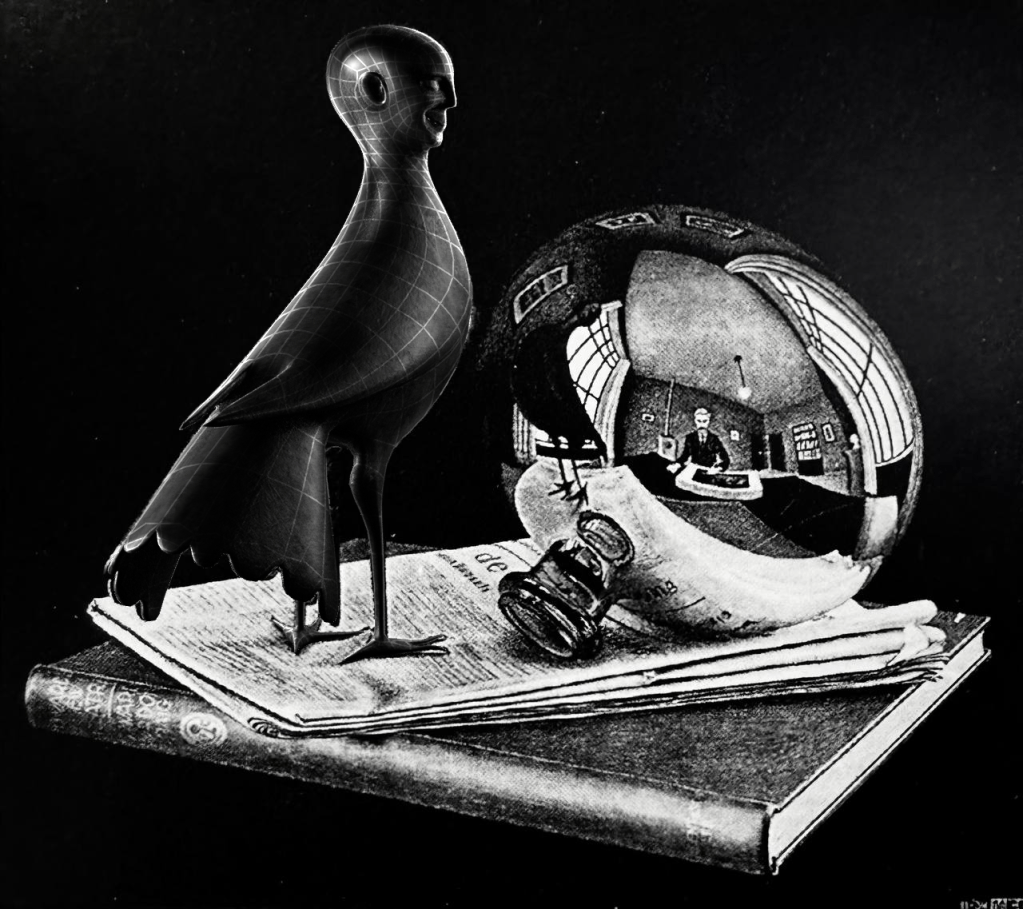
To bring this bird to life in 3D I meticulously studied Escher’s artwork Still life with spherical mirror (1934), I think its firs appearence. The approximate camera lens (in this case, a 75mm, for anyone inspired to try it themselves) became a key starting point. By aligning the perspective using empirical methods—the book within the piece offered a crucial visual cue—I was able to recreate the mysterious anthropomorphic bird with careful attention to Escher’s original design.
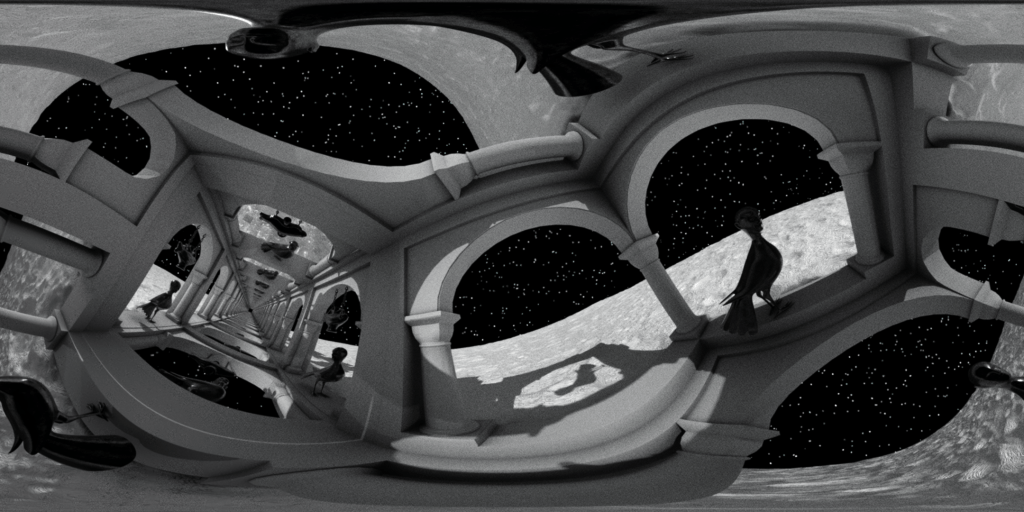
From there, I set to recreating the hall of corridors and classical arches—those ancient, dreamlike structures that seem to float in the depths of galaxies, beneath a sky teeming with stars and lunar light. The modular design of the gallery lent itself to endless possibility; it was easy to extend its corridors into infinity. Yet that wasn’t my ultimate goal. I wasn’t just building a replica; I wanted to inhabit Escher’s art, to step into the mind-bending dimensions of Other World II. This desire led me to experiment with panoramic lenses and fluid camera movements. In some of my experiments with equirectangular lenses, the effect becomes dizzyingly hypnotic—an experience not for the faint of heart!
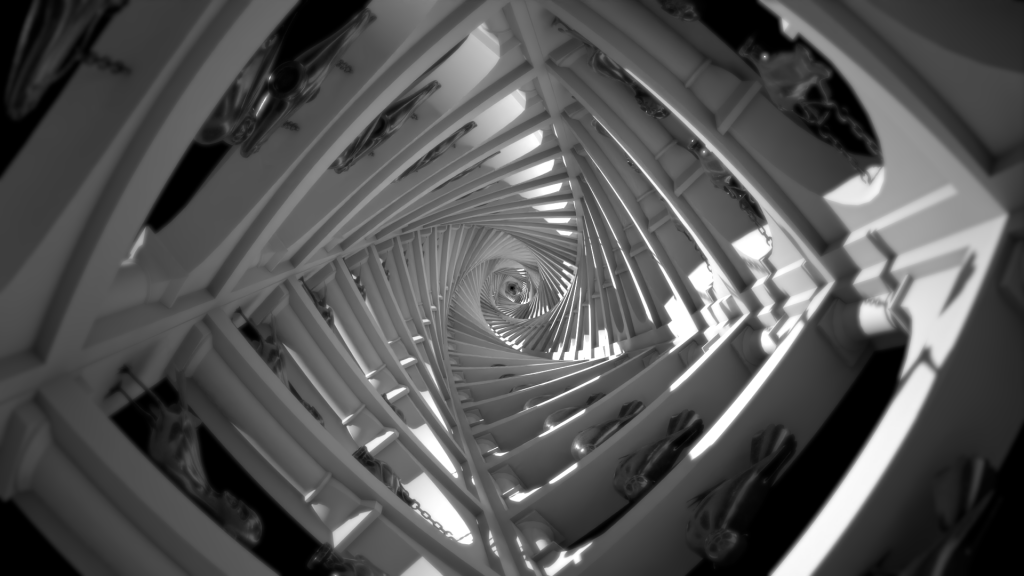
What continues to fascinate me is how the work takes on a mesmerizing, almost hallucinatory quality when viewed through a fixed, central camera. By anchoring the lens in place and allowing it only to rotate, the gallery morphs into a surreal vortex—a dimension I truly believe Escher would have delighted in.
Still, these explorations rank among my favorite projects. There’s a particular magic in revisiting old work with a fresh perspective, finding new ways to breathe life into it.
 Andrea Cigognetti