
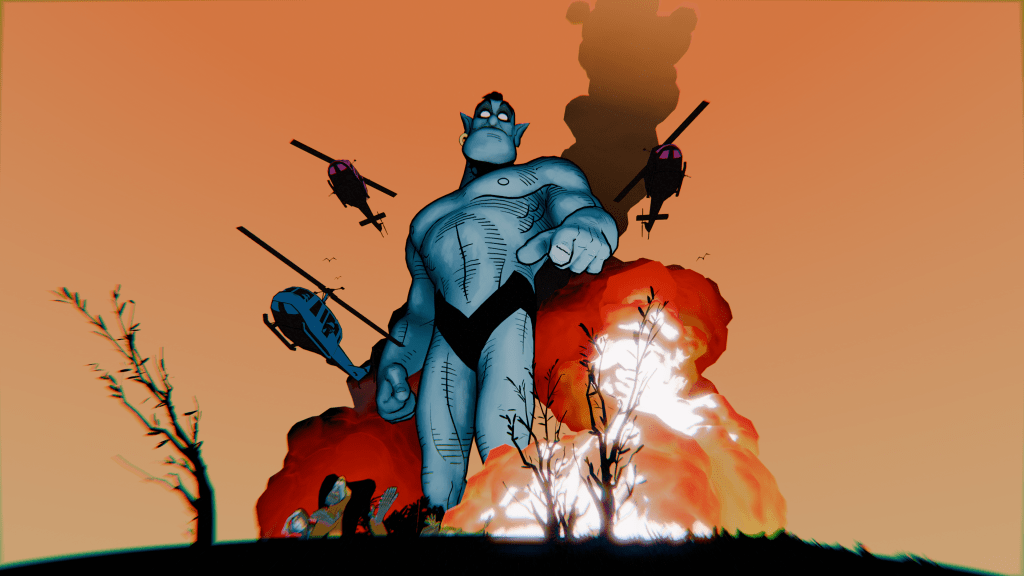
The worlds of animation and comics have given us some of the most iconic blue-skinned figures, embodying both limitless power and detachment from humanity. The Genie from Disney’s Aladdin, Dr. Manhattan from Watchmen, and the intricate characters from The Thief and the Cobbler may seem disparate at first glance, but they are connected by deeper threads: their relationships to themes of divine power, artistic ambition, and, at times, creative destruction. A conceptual 3D artwork that mashes up these characters—a towering hybrid of the Genie and Dr. Manhattan obliterating the world of The Thief and the Cobbler in the style of Dr. Manhattan’s Vietnam victory—captures the collision of artistry, power, and cultural legacy in an arresting visual metaphor.
The Genie and Dr. Manhattan both stand as modern reflections of blue-skinned archetypes, reminiscent of Southeast Asian deities like Vishnu and Krishna. In Hinduism, blue symbolizes the infinite—the vastness of sky and ocean, the cosmic. Similarly, the Genie’s cobalt skin underscores his boundless magical abilities, playful yet trapped within the confines of servitude. Dr. Manhattan’s luminous blue, by contrast, highlights his detachment from humanity as he evolves into a godlike being capable of reshaping matter and time itself. Both figures exist apart from mortals: one as a whimsical wish-granter, the other as an omnipotent, apathetic observer. This shared symbolism of blue ties them to ancient traditions of power and divinity, but it also underscores the emotional distance their gifts impose on them.
Meanwhile, the connection to The Thief and the Cobbler introduces another layer of meaning: the collision of creativity and cultural influence. Richard Williams’ decades-long dream of crafting an animated masterpiece was an attempt to elevate animation to an unparalleled artistic height. His use of Middle Eastern aesthetics, geometric intricacies, and silent storytelling mirrored the transcendence found in religious art. Tragically, the film’s troubled production and eventual reworking into a Disney-style product robbed it of its original vision. Simultaneously, Disney’s Aladdin—which bore striking resemblances to Williams’ project—became a cultural phenomenon, overshadowing his painstaking efforts. The parallels between Dr. Manhattan’s detached destruction and Disney’s overwhelming cultural dominance are impossible to ignore.
A 3D artwork depicting a hybrid Genie-Dr. Manhattan figure obliterating the characters of The Thief and the Cobbler captures this narrative poignantly. The Genie-Manhattan’s towering form, glowing with Persian-inspired geometric patterns, looms over a ruined cityscape, mirroring Dr. Manhattan’s infamous Vietnam War panel. The mash-up becomes an allegory for the fate of The Thief and the Cobbler, its intricate beauty destroyed by the unstoppable force of corporate animation.
This scene speaks to the deeper tension in art: the balance of individual vision and mass appeal, of innovation and commercialism. Just as Dr. Manhattan’s power divorces him from human empathy, the Genie-Manhattan’s destructive whimsy reflects how large-scale cultural forces can overwhelm even the most ambitious dreams. Yet, the brilliance of Williams’ work persists, much like the layered symbolism of the Genie and Dr. Manhattan. Together, they form a powerful meditation on creativity, power, and the fragility of vision in the face of cosmic inevitability.
 Andrea Cigognetti